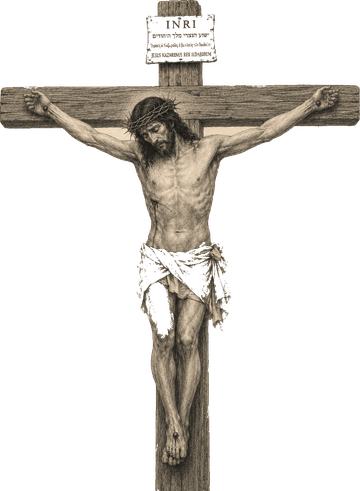
Devotion
The Sign of the Cross as a Daily Devotion
Catholic devotion
The oldest Christian gesture: a confession of the Trinity traced on the body, marking the day's beginnings and endings, its meals, its dangers, and its work with the Cross that saved us.
Background
Tertullian, writing about the year 200, already describes Christians tracing the sign at every going out and coming in, at table, at the lighting of the lamps, in all the ordinary actions of life; St. Basil counts it among the practices handed down from the apostles. It is both liturgical — every Mass, sacrament, and blessing begins and ends with it — and the simplest of private devotions, the prayer a Christian makes with the body when there are no words.
How to practice
With the right hand touch the forehead, then the breast, then the left shoulder and the right, saying: 'In the name of the Father, and of the Son, and of the Holy Spirit. Amen.' Make it slowly and deliberately rather than in haste. Use it on rising and on going to bed, before and after meals and prayer, on entering a church with holy water, when passing a church or a cemetery, at the beginning of work or a journey, and in the moment of temptation or fear. Parents may trace a small cross on the forehead of a child as a blessing.
How to practice
In the name of the Father, and of the Son, and of the Holy Spirit. Amen.
Indulgences
- Citation
Enchiridion Indulgentiarum, 4th ed. (Apostolic Penitentiary, 1999), which lists the Sign of the Cross, made with the customary words, among the prayers enriched with a partial indulgence. The governing norms are those of Paul VI, Indulgentiarum Doctrina (1967).
Content subtype
general