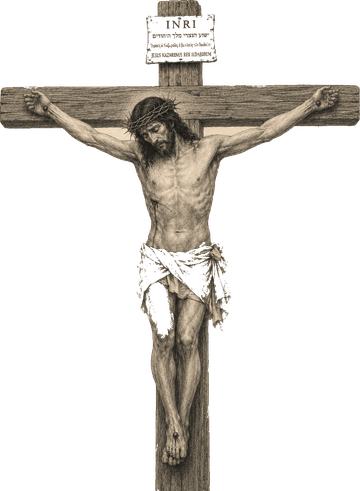
Lent
How to Keep Good Friday
Lenten guide · 8 steps
The one day of the year without Mass: the fast and abstinence, keeping the day quiet, the three o'clock hour, the Celebration of the Lord's Passion, venerating the Cross, the Stations, and Holy Communion from the reserved Sacrament.
8 steps · About 30 minutes
Good Friday is the day of the Lord's death, and the Church keeps it unlike any other day. No Mass is celebrated; the altar is bare, the tabernacle empty, the church stripped. In place of Mass, the Church gathers, usually at three in the afternoon, the hour Jesus died, for the Celebration of the Passion of the Lord: the Word, the Cross and Communion. It is a day of fast and abstinence for every Catholic, and a day for silence. Kept properly, it is one of the most beautiful days of the year, precisely because nothing on it is comfortable.
What you need
- The time of the Celebration of the Passion at your parish, and of any Stations of the Cross
- A plan for the fast: one full meal, two small ones, no meat
- A crucifix at home, to pray before in the morning and evening
- Money for the Good Friday collection for the Holy Places
When to pray it
Good Friday, the Friday before Easter. The Celebration of the Passion is normally at three in the afternoon; parishes may hold it later for those at work, but never in the morning. The Divine Mercy Novena also begins on this day.
Steps
Step 1: Keep the fast and abstinence
Good Friday is one of the two days of obligatory fasting and abstinence in the year. Fasting binds Catholics aged 18 to 59 and permits one full meal, and two smaller meals that together do not add up to a full meal, with nothing eaten between meals (liquids are permitted); abstinence from meat binds everyone 14 and older. The sick, and pregnant or nursing women, are excused. Make the fast a real one: eat the small meals plainly and let the hunger of the day remind you of the One who thirsted on the cross. Many families keep the full meal until after the afternoon liturgy.
Step 2: Keep the day quiet
Begin the morning before a crucifix, praying the slowly, and decide then what the day will not contain: no music, no screens beyond what work requires, no shopping, no entertaining. Good Friday has no obligation to attend the liturgy, but it has a spirit, and the spirit is mourning. If you must work, keep an inner silence and take a few minutes at three o'clock wherever you are. If you are free, the traditional way to pass the morning is the Stations of the Cross, the Sorrowful Mysteries or the reading of the Passion from Saint John's Gospel at home.
Step 3: Mark the three o'clock hour
Jesus died at the ninth hour, three in the afternoon. Wherever you are at three o'clock, stop, and at least pray the () or an act of love for the dying Lord. Good Friday is also the day on which, at Jesus' request to Saint Faustina Kowalska, the Divine Mercy Novena begins, running the nine days to Divine Mercy Sunday, and the three o'clock Hour of Mercy she was asked to keep is fitting on this day above all. If your parish's liturgy is at three, this is the hour you will be in church; if it is later, keep the hour privately and go in the evening.
Step 4: Take part in the Celebration of the Lord's Passion
The liturgy begins in silence: the ministers enter without music and the priest prostrates himself before the bare altar while everyone kneels. The Liturgy of the Word follows, with Isaiah's Suffering Servant, Psalm 31, the Letter to the Hebrews, and the Passion according to John, read or sung with the people taking part. Then come the Solemn Intercessions, ten prayers for the Church, the Pope, the clergy and faithful, catechumens, Christian unity, the Jewish people, those who do not believe in Christ or in God, those in public office, and those in tribulation, each with a call to kneel and to stand. Stay attentive; this is the Church praying for the whole world on the day the world was redeemed.
Step 5: Venerate the Cross
A single cross is brought forward, unveiled in three stages or carried through the church, and shown to the people while the priest sings 'Behold the wood of the Cross, on which hung the salvation of the world', and all reply 'Come, let us adore' and kneel a moment in silence. Then everyone comes forward in procession to venerate it: approach, make a genuflection or a profound bow, and kiss the cross or touch it with your hand, as the parish's custom is, and then return to your place. While the line moves, the choir sings the Reproaches and the ancient hymns of the Cross. Devout participation in this adoration of the Cross in the Good Friday liturgy carries a plenary indulgence under the usual conditions.
Step 6: Receive Holy Communion from the reserved Sacrament
Since no Mass is celebrated, the Blessed Sacrament consecrated at the Mass of the Lord's Supper is brought from the place of repose to the altar. All pray the Our Father together, the priest shows the Host with 'Behold the Lamb of God', and Communion is distributed as usual, under the form of bread alone. Receive with the same reverence and the same conditions as at any Mass: in a state of grace and having fasted for an hour, which today is no difficulty. There is no blessing at the end; the ministers leave in silence, and the church is left bare until the Vigil.
Step 7: Pray the Stations of the Cross
On no day are the Stations more at home. Most parishes pray them publicly on Good Friday, in the morning, at noon, or after the afternoon liturgy, and many walk them outdoors. Go if you can, or pray them at home with the How to Pray the Stations of the Cross guide, kneeling at each station for the versicle 'We adore you, O Christ, and we praise you' with its response 'Because by your holy Cross you have redeemed the world.' The Stabat Mater, sung between the stations, gives Our Lady's place at the foot of the Cross its voice.
Step 8: End the day in silence
Keep the evening as you kept the day. If you have not yet had your one full meal, take it simply now. Pray the Stabat Mater or the Seven Sorrows with Mary, who kept this night, and go to bed early; tomorrow the Church waits at the tomb, and tomorrow night she keeps the Vigil. Consider continuing the fast through Holy Saturday, as the Church commends, so that the first food of Easter tastes like what it is.
Tips
- Ask for the afternoon off, or the whole day, well ahead. Good Friday is not a public holiday in most of the United States, and the liturgy is at three.
- Keep the fast through Holy Saturday until the Easter Vigil if you can; the Church specifically commends this paschal fast.
- Turn off music, television and social media for the day. Silence is the Church's own way of keeping Good Friday.
- Do not expect to receive absolution during the liturgy; confess on Monday, Tuesday or Wednesday of Holy Week instead.