Family
How to Teach a Child the Basic Prayers
Family life · 7 steps
The Sign of the Cross, grace at meals, the Guardian Angel Prayer, the Our Father, the Hail Mary, the Glory Be and the Act of Contrition, taught age by age at home.
7 steps · About 15 minutes
Parents are the first teachers of prayer. Saint John Paul II wrote in Familiaris Consortio that the concrete example and living witness of parents is fundamental and irreplaceable in educating children to pray, and that the mother and father who pray with their children reach their hearts in a way no one else can. Children do not learn prayers from books; they learn them from the lips of someone who loves them, repeated at the same moments every day until the words become their own. This guide gives the order in which the Church's basic prayers are usually taught and the simplest way to teach each.
What you need
- The prayers yourself, known by heart — a child copies what you know, not what you look up
- Fixed moments: waking, meals, bedtime
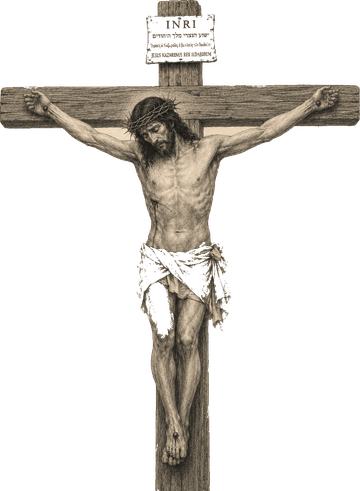
- A crucifix or holy picture in the child's room, and a rosary or holy card of their own
- Patience with mispronunciations; they are part of the charm and correct themselves
When to pray it
Every day at the same moments, from infancy: the Sign of the Cross and a short blessing over the baby, grace at meals as soon as the child sits at the table, bedtime prayers from the first words. A child should know the Our Father, the Hail Mary, the Glory Be and the Act of Contrition before first confession and Communion, usually around age seven.
Steps
Step 1: The Sign of the Cross (from infancy)
Begin before the child can speak. Trace the cross on the baby's forehead at bedtime, as the priest did at baptism, and say the words: 'In the name of the Father, and of the Son, and of the Holy Spirit. Amen.' As soon as the child can move a hand, guide it: forehead, breast, left shoulder, right shoulder. Every prayer you teach will begin and end with this sign, so it is learned by sheer repetition. Explain, when the child is old enough to ask, that it says who we belong to and what Jesus did for us.
Step 2: Grace at meals (as soon as the child sits at the table)
Grace is the first prayer a child prays with the whole family, and the first one they can lead. Say it together at every meal: 'Bless us, O Lord, and these thy gifts, which we are about to receive from thy bounty, through Christ our Lord. Amen.' A two-year-old will say 'Amen' with great conviction; a four-year-old can say the whole prayer. Let the child lead grace on their birthday and on feast days, and add the as the family's habit allows.
Step 3: The Guardian Angel Prayer (bedtime, from the first words)
The is short, rhymes, and answers a small child's fear of the dark: 'Angel of God, my guardian dear, to whom God's love commits me here, ever this day be at my side, to light and guard, to rule and guide. Amen.' Pray it at bedtime with the , kneeling by the bed or sitting on it. Tell the child, in a few words, that God has given them an angel who watches over them; the Catechism teaches that every person has one. This is usually the first prayer a child can say alone.
Step 4: The Our Father (around ages four to six)
The is the prayer Jesus taught, so teach it as such: 'This is how Jesus told us to talk to God.' Say it every night, one phrase at a time, and let the child echo each phrase until the whole prayer flows. Explain the hard words in a sentence — 'hallowed' means holy, 'trespasses' means the wrong things we do. A child who knows the can join in at Mass, and that is a great moment: point it out to them the first Sunday they pray it with the whole church.
Step 5: The Hail Mary and the Glory Be (around ages five to seven)
Teach the from the Gospel: the first half is what the angel and Elizabeth said to Mary, and the second half is our asking her to pray for us. Say it at bedtime after the , and let the child hold a rosary while learning it. The follows quickly, because it is short: ' to the Father, and to the Son, and to the Holy Spirit; as it was in the beginning, is now, and ever shall be, world without end. Amen.' With these three prayers a child can pray a decade of the Rosary, and a single decade prayed with the family on a Sunday evening is the best way to fix them for life.
Step 6: The Act of Contrition (before first confession)
In the year before first confession, teach the : 'O my God, I am heartily sorry for having offended thee, and I detest all my sins because of thy just punishments, but most of all because they offend thee, my God, who art all good and deserving of all my love. I firmly resolve, with the help of thy grace, to sin no more and to avoid the near occasions of sin. Amen.' The parish may use a simpler approved form; learn the one the child will use in the confessional. Say it together each night after a one-minute look back over the day: what was I sorry for today? A child who has prayed it at bedtime for months will not freeze when the priest asks for it.
Step 7: Praying at bedtime: putting it together
By the age of seven the bedtime prayers can take five minutes and have a settled order: the ; the ; the ; the ; a short look back over the day and the ; prayers for named people — grandparents, a sick friend, the dead; the ; the . Keep the order the same every night, let the child lead parts of it, and bless the child at the end with a cross traced on the forehead. Familiaris Consortio says the family that prays together in this way is a domestic church; this is what that looks like at half past seven in the evening.
Tips
- Say the prayer with the child, not to the child. Pray it slowly, with the same wording every time, and let the child join in the words they know.
- One prayer at a time. Do not add the next until the last is secure; a child who knows three prayers well is better off than one who half-knows eight.
- Let the child see you pray alone. Familiaris Consortio insists that the parents' own prayer is the lesson.
- Use the parish's sacramental preparation as a check, not a substitute: catechists reinforce what has been learned at home.